


Training
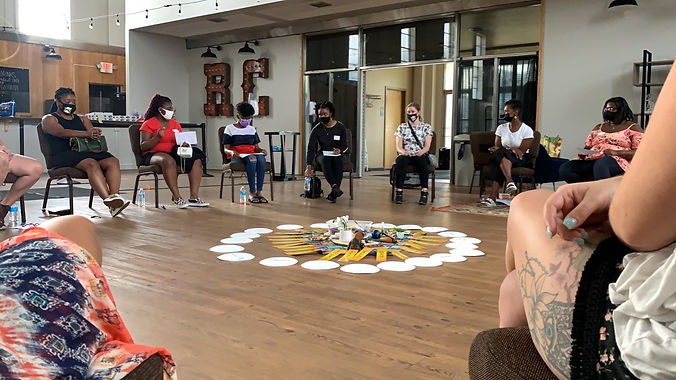
We offer a plethora of trainings to introduce Restorative Practices to communities, schools, and organizations. Our trainings incorporate short lectures, dyads, small group role plays, large group discussion, and community building games to engage participants in multiple levels of learning that keep you thinking and moving. Our goal is to keep the space interactive while giving participants hands-on practical skills to use right away.
Our Trainings
1-Day Community Training
The one-day Introduction to Restorative Practice Trainings are facilitated by experienced practitioners in the field of restorative practices. This training is designed for community members, organizations, schools and criminal justice institutions who desire to understand the basic principles, values, and processes of Restorative Practices. Participants will receive an introduction to the restorative practice continuum, including affective language, small impromptu conferencing, community building circles, and restorative justice conferencing. The overall mission is to create caring community climates based on respect, responsibility, and repair of harm. Participants will learn and experience the difference between restorative and retributive (or punitive) justice through personal stories and experiences.
2-Day Circle Certificate Training
Our Circle Certificate Training dives deeper into circle processes as a practice along the Restorative Practice Continuum. This training covers
-
Elements and Stages of the Circle process
-
How to develop shared Values and Guidelines for your community
-
Defining Restorative Practice and Restorative Justice (restorative vs retributive justice)
-
Restorative Practice Social Discipline Window and Continuum
-
Processes of restorative practices
-
Using circles to build community in schools, communities, organizations and courts
2-Day Conferencing Certificate Training
Restorative Justice Conferencing is another Restorative Practice, on the far end of the RP Continuum. A Restorative Conference is a formal restorative process responding to harm, and is an alternative to traditional punitive measures. Conferencing is voluntary, focuses on the needs of those impacted, and strives to repair the harm with the accountability and support of the community. Training participants will learn about the conferencing process and role play to practice their skills with the support of the training facilitators. Restorative Conferences can be used to address and repair harm in any context, including but not limited to work places, families, schools, neighborhoods, and as an alternative to the court room.
Organizational
Hoping to train your whole staff? Don't see something your organization is looking for? We also tailor our trainings to a specific organization's needs. Contact us using the form below to let us know some of the details, and we will follow up with you to talk over the possibilities!
Community Training
Ec
Restorative Practices Tier 1: Facilitating Circles in Community Organizations,
Colleges, and Businesses
Participants will learn theoretical foundation Restorative Practices to promote healthy
relationships, identify common values and guidelines, develop social-emotional skills,
and promote and strengthen engagement. Presenters will model circles for check-ins,
celebrations, and discussions addressing sensitive issues. (Duration 7.5 hours)
Restorative Practices Tiers 2 & Managing Difficulties and Repairing Harm in
Community Organizations, Colleges, and Businesses.
Participants will learn how to lead different types of circles to prevent harm, resolve
differences, and build social-emotional capacity with students. The afternoon will
provide opportunity to role play a formal Restorative Conference to resolve a conflict.
(Duration 7.5 hours)
Workshops
Community Building Booster Workshop:
Review key elements of Circles: creating
shared values and guidelines, check in rounds, selecting prompts to promote connection and
trust, use of talking pieces and center pieces.
Restorative Conversations in the Classroom:
Participants will learn how to assess
students’ readiness to engage in process to resolve conflict and role play scenarios.
Addressing Behaviors through Community Building:
Participants will use the “Circle of Courage” model of positive youth development to understand behavior and to create plans to address challenging behavior.
Using Restorative Practices in team and family meetings:
As leaders, we can model
relationship building and problem solving using Restorative Practices. In this workshop,
participants will learn three different circle activities to use with staff and parents.
Facilitating Circles about Race:
Participants will discuss and practice using “Affinity
Circles” to discuss racial and bias with staff.
Creating a Three-Year Plans for RP Implementation:
Over the nine workshops,
participants will look at three year implementation plans and create their own plans. During
this session, participants will share their plans.
Teaching Social Emotional Skills in Circles:
Learn how SEL and Restorative Practices
are aligned, and practice using two different circle scripts “What Makes Us Feel Good” and
“Managing Mountains”.
Academic Circles:
Participants will use a circle process to assess prior learning, teach content, and prepare for exams projects and field trips.
Celebrating Success and Giving Gratitude:
Participants will practices using a circle
process to celebrate success and show appreciation for staff and students.
Aligning Trauma Informed lens and Social Emotional Learning with School Wide
Restorative Practices:
Educators face implementing multiple initiatives each year. In this workshop, participants will discuss how community building circles provide opportunities to teach and practice social emotional skills and increasing understanding among staff and
students.
Evaluating School Wide Restorative Practices:
Participants will review an assessment
tool to measure building level implementation of RP.
Facilitating Circles with Staff:
Full implementation of School Wide Restorative Practices requires that staff experience community building circles. During this workshop, teachers
will practice using two staff circles that support teamwork and collaboration.
Using Community Building Circles to Engage Families and Community:
Participants will practice using “Parent-Teacher Conference” and “Feedback to the School” scripts.
Addressing Chronic Truancy with Restorative Practices:
Participants will reflect on
traditional school responses to excessive absences and learn how to engage with students
and families to address obstacles to attendance and create plans to improve attendance.
Grievances verses Gripes - A Restorative Approach to Restorative Practices:
Not all conflicts among staff are contractual or can be addressed with a formal human resource process. In this workshop, participants will role play a conflict between two staff members using a restorative conversation.
Restorative Script for IEP Meetings:
To promote inclusion within IEP process,
participants will role play circle script for Special Education meetings.
Pricing
ECRJC tries to practice equity in all we do, including pricing. As such, we will do our best to work with you to construct a training that meets the needs and budget of both your organization and our training team.
Request a Training
Want to request a specific training? Please fill out the following form! We need at least ten participants for our personalized trainings, and at least a month's notice to guarantee a place on our calendar. Thank you!